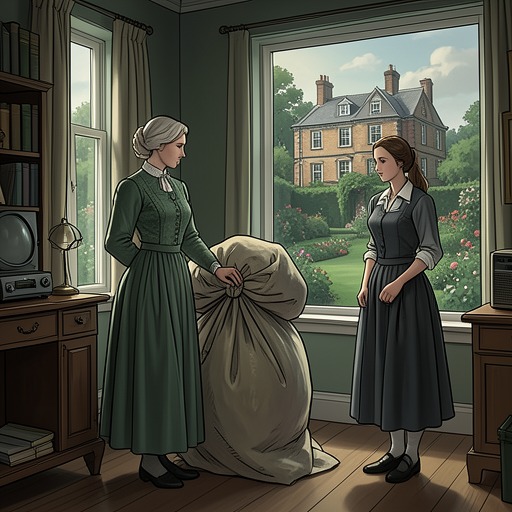
Verity Lockett
Mothering SundayVerity Lockett, first known to Sunday Small as Miss Beau, is the workhouse teacher whose steady affection offers Sunday an alternative to the institution’s harshness. An orphan herself, Verity recognizes the importance of care and acts on that recognition: she teaches the girls, spends time with the babies, and helps in the sick wing, while also challenging the matron’s treatment of the children. Her story connects private kindness with public responsibility, as she later helps bring the workhouse’s neglect into view and supports efforts to improve conditions.
Identity and Background
Verity had been orphaned in her late teens. For a time she worked as a governess in one of the large houses outside Nuneaton, then took a post teaching girls at the workhouse. By the time she was approaching thirty, she had begun to fear that she would remain unmarried. She lived in a small rented room in a terraced house on Henry Street, a modest arrangement that was soon to change through her marriage to Edgar Lockett.
She met Edgar while helping at Sunday school, where they both gave religious instruction to the orphans. Their relationship developed into an engagement, and Verity looked forward to leaving her rented room for the vicarage. Her hopes for marriage matter not as a substitute for her working life but alongside it: Verity is both a woman seeking a secure personal future and a teacher attentive to children whose own security is precarious.
Work at the Workhouse
Verity’s role places her inside an institution organized by separation and labor. The residents were divided into sections for women, boys, girls, and men; women and girls were assigned work such as sewing, cooking, cleaning, and laundry, while some men and boys picked oakum, crushed bones, or worked in the gardens. Residents rarely came together except on Sundays. Verity’s daily contact with the girls, babies, and sick inmates gives her a view of the people behind this rigid arrangement, and she does not treat the workhouse’s procedures as beyond question.
She regularly clashes with Miss Frost. Verity asks questions and makes forthright suggestions about discipline and the children’s diets, provoking the matron’s anger. Sunday sees her as the only adult willing to stand up to Miss Frost. Verity’s position is not without vulnerability: Sunday wonders why she has not been dismissed, and the narrative links her relative protection to her engagement to Edgar, an influential local vicar. Her ability to challenge the matron thus reflects both personal courage and the social standing afforded by her connection to him.
Verity’s care is not confined to criticism. When she learns that Sunday has been confined in the punishment cell, she has just returned after two days at home ill with a chill. She goes down to the cell, finds Sunday weak, and immediately takes her upstairs to be cleaned up, asking whether she has had anything to eat or drink. Sunday explains that she was kept without food or water for three days and had needed the sickbay after her release. Verity’s response turns concern into intervention: she does not leave Sunday alone with the consequences of the punishment but attends to her immediate needs.
Relationship with Sunday Small
For Sunday, Verity is more than a teacher. Sunday remembers her as the only adult who had shown her affection. Verity had told her that, as a baby in the nursery after being found on the workhouse steps, Sunday was the only infant who cried. The remembered story binds Sunday’s beginnings to Verity’s care for the nursery children, and helps explain why Sunday’s loyalty to her is so profound.
That bond does not make Verity careless about the risks Sunday faces. When Sunday is already in trouble, Verity warns her not to get into further difficulty and says she will check on the girl at the center of the immediate concern. Later, as Verity’s pregnancy approaches, the girls miss her when she is absent, though they are glad for her happiness. She notices Sunday’s subdued manner and the uneven clumps of hair on her forehead, asks what has happened, and tells her to remove her bonnet. The moment shows a teacher still alert to a child’s distress even as her own life is changing.
After her marriage, Verity remains attentive to Sunday. At church she greets the congregation alongside Edgar, holding their baby Phoebe, then draws Sunday aside to ask how her new situation is going and whether she is being treated well. She also offers to have Sunday stay for lunch at the vicarage after the morning service. From there, Sunday would have an easier journey to the workhouse to see Daisy Branning and Tommy Branning, without having to return home and travel back again. Verity makes the invitation conditional on Biddy Spooner’s agreement, respecting the household in which Sunday is employed while offering practical help to maintain her connection with the children.
Marriage, Family, and Wider Care
Verity’s marriage to Edgar brings her from her rented room on Henry Street to the vicarage. She becomes Mrs Lockett, and the couple have a daughter, Phoebe. Later, when the vicar and his wife take Cissie Burns back to Treetops Manor in their cart, Phoebe is with her mother. Verity’s home and family life therefore appear alongside her continuing involvement in the lives of vulnerable people beyond her own household.
Her care also extends to Lady Lavinia Huntley and Stephen Huntley. After Lavinia visits to meet Verity and Edgar’s newborn son, Michael, she fears that the visit may have exposed Stephen to measles; no one had known that Phoebe was becoming ill. When Stephen becomes gravely sick during the epidemic, Verity visits him, and Lavinia takes comfort in knowing that Verity and Edgar are praying for him. The episode places Verity within a network of personal support, while showing how illness can cross the boundaries between households despite the good intentions of those involved.
Verity’s concern for the workhouse develops into practical advocacy. She reports that conditions have improved after the change in management: meals are better, fear and bullying have receded, and the new matron has broken Miss Frost’s split cane and thrown it away. Verity wants the improvements to continue and proposes new bedding, noting that the existing blankets are inadequate. Her attention to food, punishment, and bedding makes reform concrete: better treatment means changes to the ordinary conditions in which residents live, not merely a change of personnel.
Narrative Role and Significance
Verity’s importance lies in the movement from individual kindness to sustained responsibility. Sunday’s attachment to her begins with affection and protective action, but Verity also uses her knowledge of workhouse life to identify failures and support better provision. Her engagement to an influential clergyman helps explain why she can question Miss Frost without being dismissed; her own experience of orphanhood and service helps explain why she remains attentive to the children’s needs. The narrative places those factors together without making her challenge effortless or her influence unlimited.
She also serves as a reliable connection between settings and generations. As a teacher, she knows the children at the workhouse; as Edgar’s wife, she can offer Sunday a welcoming place to visit; as a mother, she experiences the vulnerability of infants within her own family; and as a friend to Lavinia, she participates in a wider circle of support. By the time Verity advocates new bedding and continued reform, care has become more than a private tenderness: it is a practical standard by which institutional life can be judged.